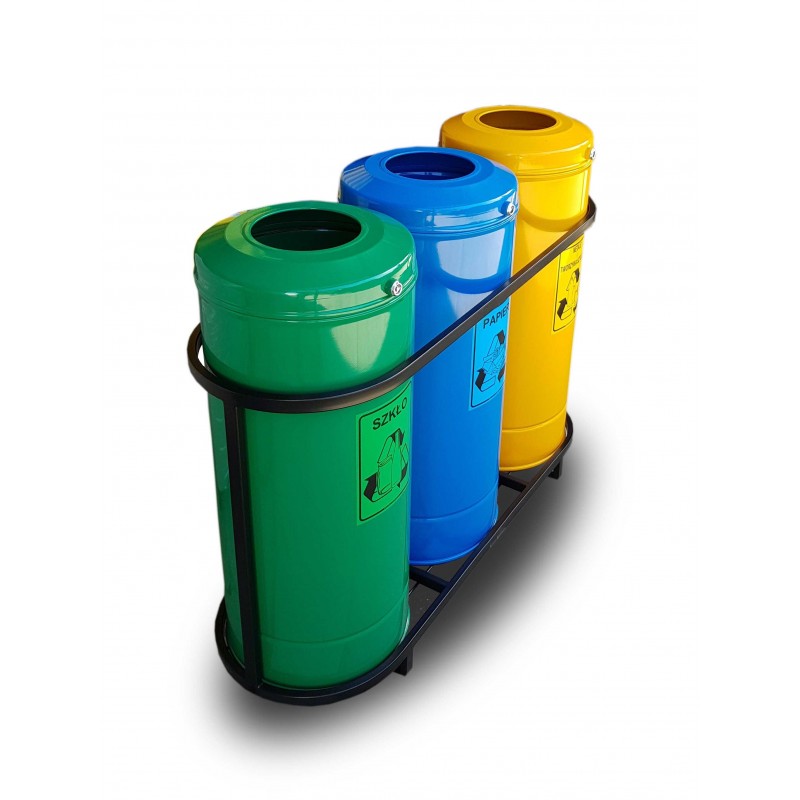
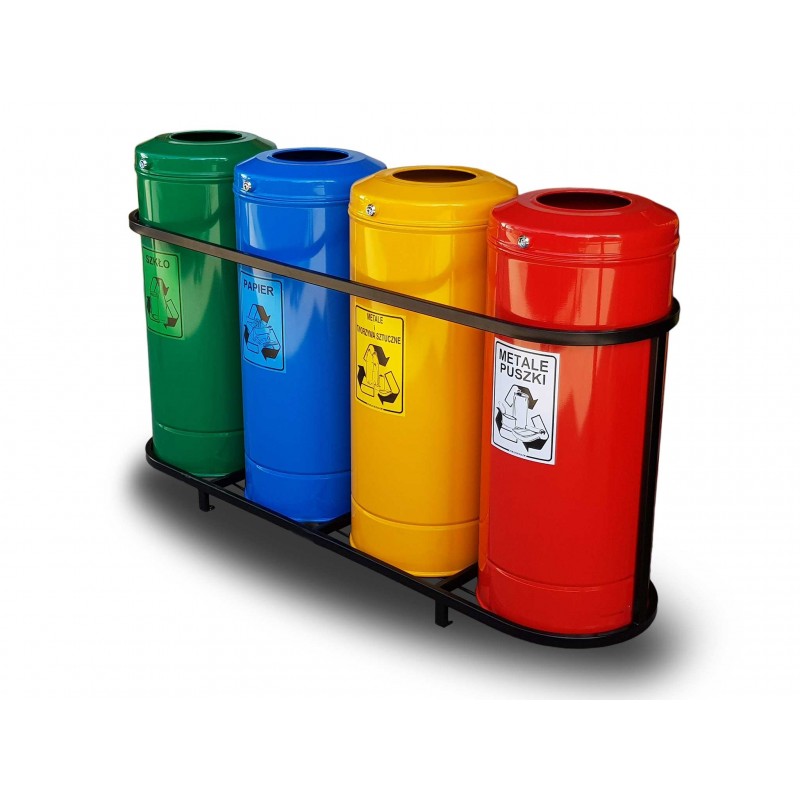
Sets are just one of several variants offered within the Recycling bins category. Recycling bin sets are ready-made combinations of several containers placed together, covering all the basic waste streams. They save time when setting up a recycling point from scratch, with no need to assemble individual elements. This solution is popular with managers of new developments and when upgrading existing waste collection areas.
The individual compartments of a set are marked with colours and pictograms in line with the nationwide sorting system, making it easier for users to separate waste correctly without having to read additional instructions at each bin.
A recycling bin set typically comprises two to five connected compartments corresponding to the basic waste streams: paper, glass, plastics and metals, mixed waste and biowaste. The compartments are manufactured both from plastic, which is lightweight and moisture-resistant, and from galvanised or powder-coated sheet steel, chosen where greater resistance to mechanical damage and vandalism is required.
The advantage of a ready-made set over assembling individual bins is that all elements have a consistent height, opening width and style from the outset, so there is no need to search for matching models separately for each waste stream. This is particularly appreciated when fitting out new housing estates, office buildings or educational facilities, where the visual consistency of the equipment matters for the overall perception of the space.
Sets are available both in a fixed version, anchored permanently to the ground, and in a freestanding version that can be moved elsewhere if necessary, for example when reorganising a waste collection point on a housing estate. The permanently fixed version is better suited to high-traffic locations where there is a risk of the container being accidentally moved or knocked over.
When choosing a set, it is worth considering not only the number of compartments but also the capacity of each in relation to the actual quantity of waste generated in each stream. Proportions are often uneven: for example, offices usually produce more paper waste than glass, which should be taken into account at the selection stage to avoid one compartment needing frequent emptying while the others remain almost empty.
After several years of intensive use, it is worth considering replacing the labelling on the individual compartments, even if the containers themselves remain in good technical condition. Faded or damaged pictograms genuinely reduce sorting effectiveness, as residents stop trusting the colour coding and begin throwing waste randomly into the nearest available compartment.


Contact
Need help choosing?
If you are not sure which solution is right for your space, please contact us. We will help you choose products tailored to your needs.