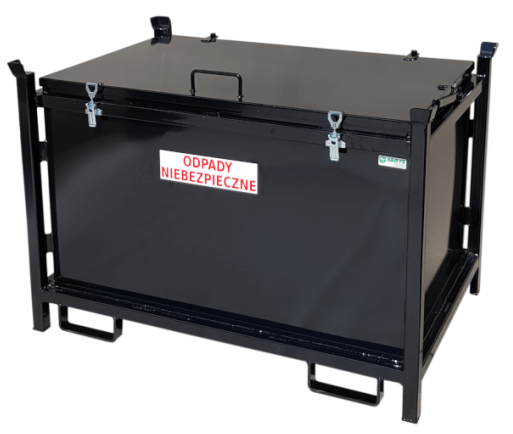
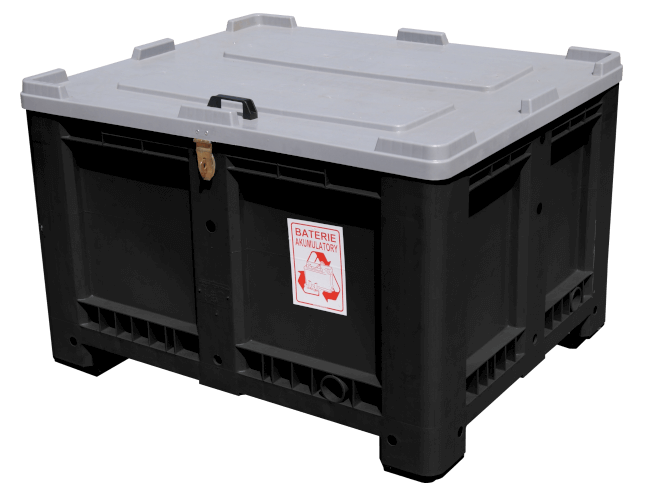
Resistance to contact with chemically aggressive substances is a feature shared by products in the hazardous waste containers section, to which these containers also belong.
Battery (accumulator) containers are designed for the safe storage of used vehicle and industrial batteries. Their corrosion-resistant construction protects against electrolyte leakage and contact with the surroundings.
Essential equipment for car repair workshops, service stations and WEEE collection points.
A reinforced base and carrying handles make it easier to move the container despite the considerable weight of the batteries stored. We recommend regular collection of the contents by an authorised operator before the container approaches its maximum permissible load.
The storage of used batteries is subject to particular requirements due to their electrolyte and heavy metal content. Containers for this purpose are therefore designed to provide full protection against substances escaping into the environment: a leak-proof base, raised edges and chemical resistance of the material are the basic requirements for this type of equipment.
Acid-resistant plastic, most commonly high-density polyethylene, remains the dominant material in this category because, unlike metal, it does not corrode on contact with electrolyte, even in the event of a minor leak from a damaged battery. Additional structural reinforcement at critical points, such as the corners and base, reduces the risk of cracking under the weight of the contents.
The size of the container is chosen according to the expected number of batteries stored between collections. Car repair workshops with a high customer turnover usually need larger containers than small service points where batteries are sent for disposal only occasionally. Available storage space should also be taken into account, as for safety reasons battery containers should be kept away from heat sources and flammable materials.
Carrying handles and the option of moving the container with a pallet truck greatly simplify internal logistics, especially when the container is full and, given the mass of the batteries stored, may weigh considerably more than it appears at first glance. Manufacturers are increasingly designing the container base so that the forks of a truck can be inserted directly, without the need to transfer the contents.
Once full, the container must be collected by an operator authorised to transport and process hazardous waste. Lead-acid batteries are recycled in specialised facilities, where both the lead and the casing plastic are recovered. Proper storage and timely collection therefore matter not only for workplace safety but also for the entire raw material recovery chain.


Contact
Need help choosing?
If you are not sure which solution is right for your space, please contact us. We will help you choose products tailored to your needs.